Luxury vs. economy: what the two-tier market means for your system choice
The market is splitting between luxury and economy, and most PMS systems are really built for one side of it. We look at what that means for a conference hotel that's neither.
Luxury vs. economy: what the two-tier market means for your system choice
We've written about several of the trends shaping the hotel and event industry right now. This one is easy to read as pure market analysis — something for the leadership team, not IT or operations — but it actually has concrete consequences for which system you should choose, and how you should configure it.
Recent analysis points to a gap between the high-price segment and the economy segment that has not only persisted but intensified over the past year, with luxury hotel groups seeking to differentiate through exclusivity and distinctive experiences, while economy hotels are simultaneously struggling with lower demand and increased competition. This isn't just a pricing conversation. It's two different operating models placing entirely different demands on the system meant to support them.
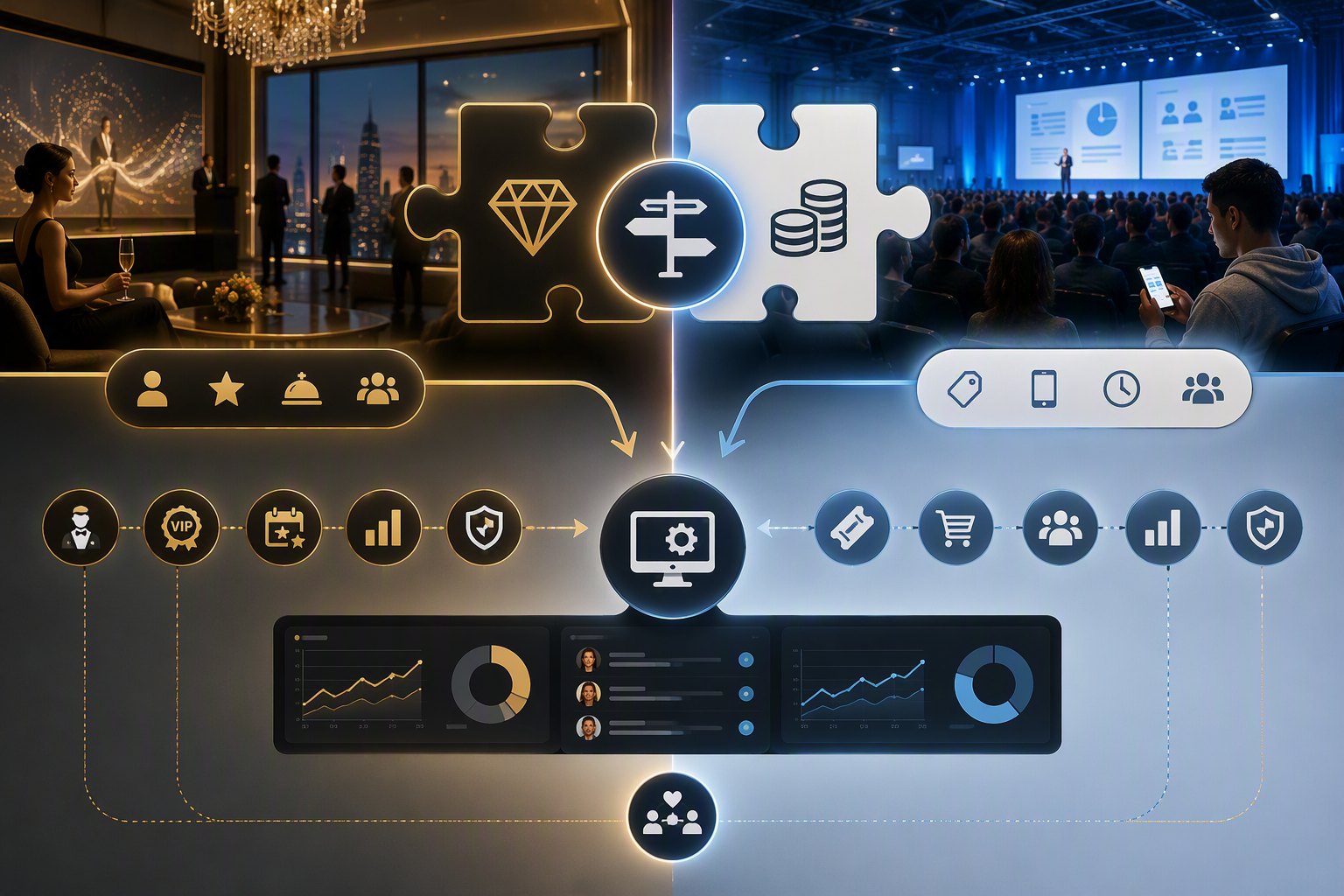
What the luxury segment actually needs from a system
The luxury segment doesn't compete on price or volume. It competes on whether the guest feels seen, remembered, and understood better than anywhere else they could have chosen. That places different demands on a PMS than most people think of first:
Deep guest history that's actually used actively — not just stored. If a guest prefers a particular room, a specific pillow, or always orders the same wine at dinner, the system should make that information available to staff before the guest arrives, not just be searchable in a database nobody checks.
Flexibility in pricing and packages that doesn't force everything into standardized categories. A luxury experience is often bespoke — a private dinner, a custom-arranged activity, a unique event — and the system needs to handle this without every single customization requiring a manual workaround outside the PMS itself.
Integration with what actually creates the experience, not just the room. Concierge functions, external experience providers, special events — these need to connect to the booking, not live as separate systems nobody links together.
Revenue management built for low volume, high margin — not for filling as many rooms as possible, but for optimizing value per guest and per stay.
What the economy segment actually needs from a system
The economy segment plays an entirely different game: competing on price and efficiency in a market where travelers have become more cost-conscious and operating costs keep climbing, while revenue growth has slowed. It's pressure toward profitability, not rate growth — and the system needs to contribute to exactly that.
Here it's about automating everything that can be automated — self-service check-in, minimal manual administration per booking, and staffing models that can handle one employee managing multiple guests at once without a noticeable drop in quality.
Dynamic pricing that reacts quickly to demand, without manual intervention for every adjustment. In this segment, margins are thin enough that one bad pricing decision in a given week is actually felt on the bottom line.
Scalability across multiple properties at once, since the economy segment is often run as chains or portfolios where one system has to manage many units without each property requiring its own manual follow-up.
The real challenge: you're probably neither
Here's the point that's easiest to miss, and the one we think is most relevant for a Norwegian conference hotel: you're probably neither pure luxury nor pure economy. You sell a combination of accommodation and conferences/events, often to corporate customers who value something other than either of the two pure models above — reliability, flexibility on group size, and the ability to handle an event as a whole, not just a room.
We've written about this before in our market overview: the large, general PMS platforms are usually built and priced with an average hotel in mind, and that average is rarely something a Norwegian conference hotel actually recognizes itself in. The two-tier market makes this even clearer — many international systems are, in practice, optimized either for luxury chains with enormous customization budgets, or for economy chains with enormous volume to justify automation at scale. A mid-sized Norwegian conference hotel often lands somewhere in between, without either of the two pure system philosophies really fitting well.
What this means concretely when choosing or configuring a system
Ask yourselves which of the two logics more closely resembles your actual guest, and build your configuration around that answer — instead of trying to be both at once, which rarely works in practice.
If you lean more toward the luxury logic (lower volume, higher value per guest, strong focus on corporate customers booking entire events), you should prioritize the system's ability to handle guest and customer history well, flexible package logic, and tight integration between sales/CRM and the actual execution of the event — more than pure volume automation.
If you lean more toward the economy logic (high volume of smaller, more standardized bookings alongside the conference business), you should prioritize automation, self-service, and dynamic pricing higher than deep per-guest personalization.
Most conference hotels will probably land somewhere in between, with the weighting shifting by season — more luxury logic in high season with fewer, larger events, more economy logic in low season where volume and efficiency matter more. A system that forces you to pick one logic permanently fits poorly with that reality. A system that lets you adjust the weighting of modules and focus throughout the year, without switching the entire platform, is worth looking for specifically for this reason.
It's, at bottom, the same advice we've given throughout this blog series, just seen through a new lens: ask which reality the system actually needs to support, before you let a general market trend or a convincing demo decide the answer for you.