How AI will change the guest and attendee journey over the next two years
Guests will soon stop booking themselves — an AI agent will do it on their behalf. We look at what that actually means for a conference hotel over the next two years, and what's still pure hype.
How AI will change the guest and attendee journey over the next two years
We've written a lot about what AI means for the people running the system. This post flips the perspective: what does it mean for the guest booking a room, or the attendee registering for a conference? We've gone through several recent industry reports to separate what's actually happening now from what's still pure future vision.
Short version: the biggest change isn't that the guest gets a better chatbot. It's that the guest is increasingly not the one booking at all — an AI agent is doing it on their behalf. That's a shift that's easier to overlook than it sounds.
Before the stay: the guest doesn't ask anymore — the agent acts
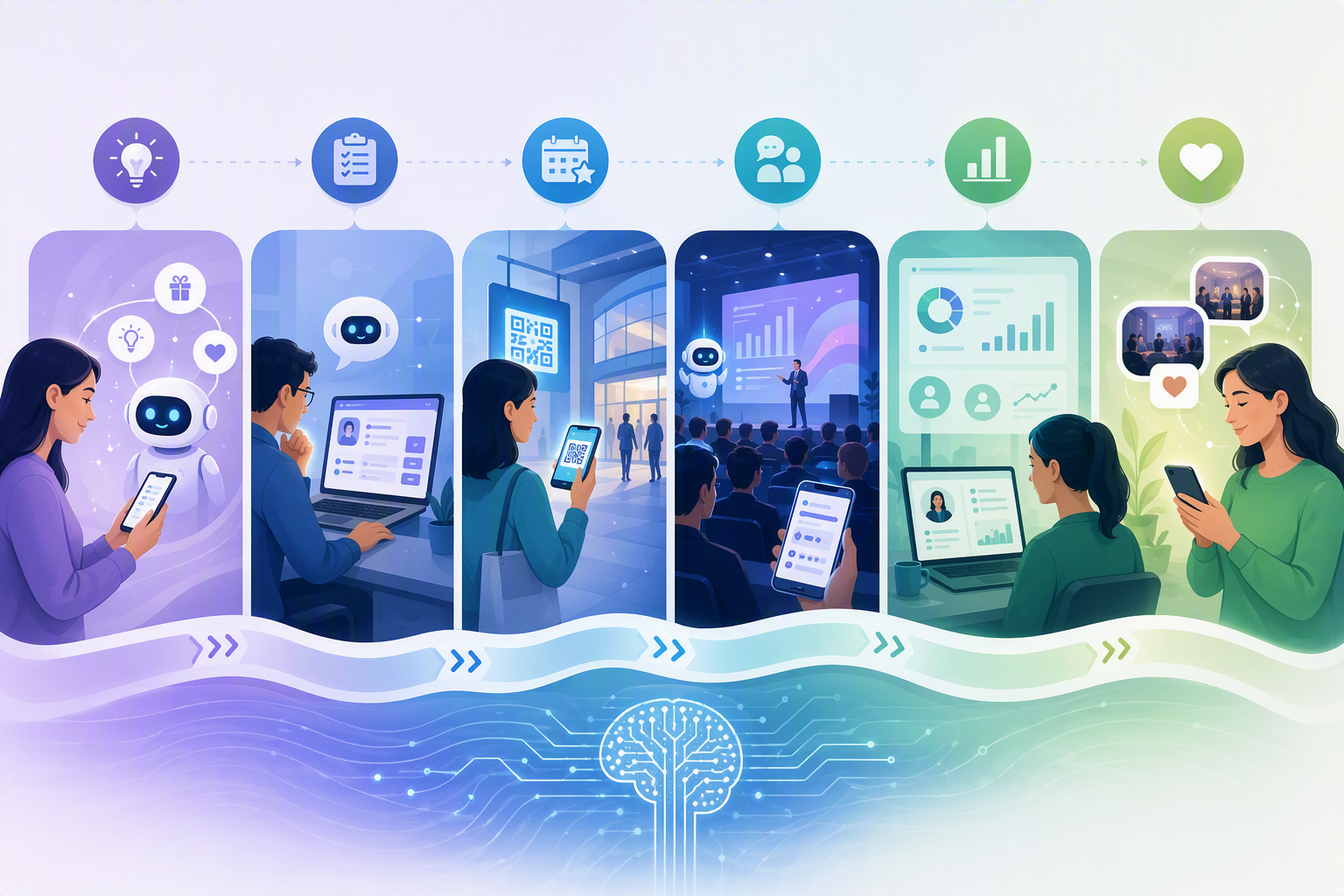
Analysts at IDC point to something worth taking seriously: over the course of 2026, more and more travelers will no longer navigate their journey themselves. An AI agent will do it for them — searching, comparing, weighing options against preferences, and eventually completing the booking itself. The question stops being "how do we get a guest to choose us on our website" and becomes "how do we get suggested at all by the agent acting on the guest's behalf."
That might sound distant for a Norwegian conference hotel right now — this is currently most visible in the leisure travel segment. But the logic applies to B2B too: a meeting planner or an assistant at a company booking conference facilities will increasingly use an AI tool to compare venues, check availability, and request offers — before a human ever visits your website directly.
The consequence for you is concrete, and not particularly surprising given what we've written before: if an agent is going to be able to suggest you, your data needs to be structured and current enough for the agent to actually find the right information. Wrong or outdated information about availability, rates, or facilities no longer just means one disappointed guest — it can mean you're never suggested by the agent at all.
During the stay: proactive, not just reactive, service
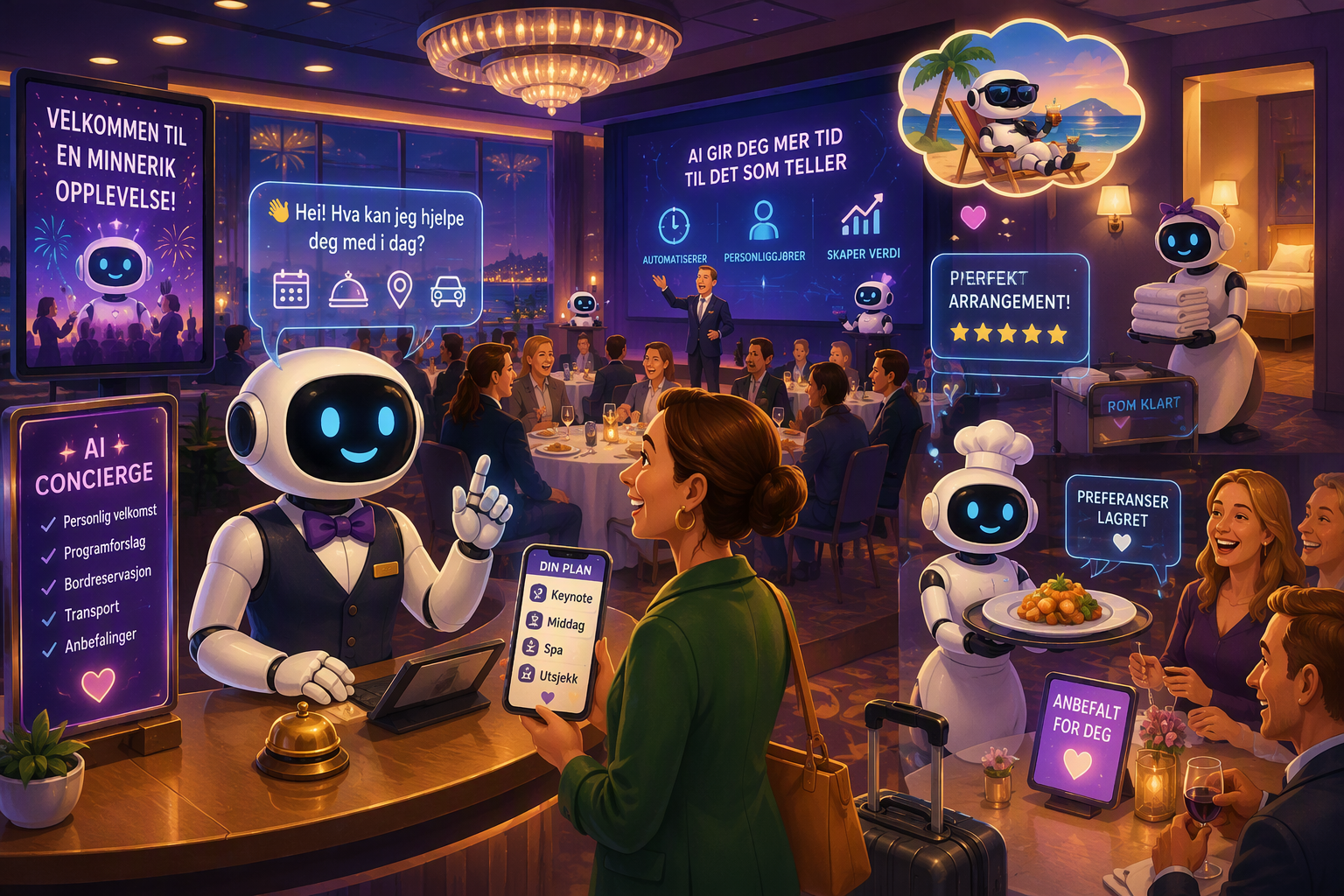
The reports consistently point to a shift from reactive to proactive guest communication. Instead of the guest having to ask for something, the system suggests it before the guest even thinks to — a spa offer on a rainy afternoon, a dinner recommendation a few hours before dinnertime, based on what the system already knows about the guest and the situation.
Chatbots and virtual concierge services today handle everything from check-in questions to room upgrades and feedback, and can in practice handle between 40 and 65 percent of guest inquiries automatically, with a measured reduction in front-desk workload of 20 to 35 percent within a few weeks of rollout. Those aren't insignificant numbers, but they should be read with the same skepticism we've applied to other AI figures throughout this blog series: these are vendor-reported averages, and your own experience will depend heavily on how well-structured your operation and data already are — something we've written about before in the context of implementation.
For the event segment specifically, it's worth highlighting something a bit different from plain guest service: real-time translation for international events, and a concierge that knows the entire program and can answer individual attendees about everything from parallel sessions to practical information, without the organizer having to staff an info desk at the same capacity as before.
Behind the scenes: a hybrid workforce, not a hotel without people
It's tempting to paint a picture of fully automated hotels with no staff. That doesn't match what we're actually seeing in the industry right now, and it's worth being honest about that. What's actually happening is something closer to a division of labor: AI takes on volume and repetition — the same ten questions asked a hundred times a week — while staff get more time for what actually requires a human: complex problem-solving, and the sense of hospitality itself that no chatbot can replace.
It's also worth noting an observation from an industry advisor: many hotels are currently testing automation mostly in back-office processes — housekeeping scheduling, revenue management — rather than in direct guest contact, likely because the perceived risk to guest experience is seen as lower there. That's a sensible order to move in, and it matches what we've recommended ourselves before: start low-risk, build trust gradually.
What can still go wrong — and what no report advertises
Here's the necessary skepticism, since it's easy to get swept up in the future-optimism of these reports. When an AI agent acts on the guest's behalf, based on data it pulls from your system, the consequence of poor data quality becomes much bigger than before. Outdated availability, inconsistent facility information, or unsynchronized loyalty data can, in the worst case, mean the guest is never suggested you at all — or, perhaps worse, that the agent promises the guest something you actually can't deliver, and the guest shows up with an expectation you never knew existed.
This isn't an argument against adopting this kind of AI. It's an argument that the groundwork — structured data, a proper API, tidy routines — matters more now than before, not less. It's exactly the same point we've made in several earlier posts, just seen from the guest's side of the table this time: the technology is rarely the bottleneck. What matters is whether you're ready for something outside your control to represent you to the guest.
What we actually expect over the next two years, concretely
We don't believe in an overnight leap where everything changes at once — the industry reports are written by vendors with their own interest in framing the change as faster than it will necessarily be for a mid-sized Norwegian conference hotel. What we think is more likely in practice: a gradual increase in booking and inquiry traffic coming via agents and comparison services instead of direct visits to your website; more proactive, but still supervised, guest communication within the systems you already use; and a clearer gap between hotels/venues with clean, structured data and those without — where the former gradually become easier to find and book, and the latter gradually become invisible to exactly the channel growing fastest.
That last point is probably the most important thing you can act on right now, regardless of how fast the rest of the shift actually plays out.